
Perry Parole and Probation
Parole and probation can both place a person in the community under rules, but they begin in different ways. Probation is a sentence ordered by the court instead of confinement or after a period of confinement. County parole is conditional release from a Perry County sentence while that sentence continues. State parole follows release from a Pennsylvania Department of Corrections institution after the Pennsylvania Parole Board acts. PADOC Field Services then supervises the state parolee.
The sentence and commitment decide the agency. Under 61 Pa.C.S. § 6132, state Board authority generally concerns state correctional sentences, while parole from county confinement remains with the sentencing court. That split matters in Perry County. A UJS sentence order showing county confinement points toward the county court and Probation office. A state commitment points toward the Parole Board and PADOC.
| Supervision | How it begins | Who handles it | Best public check |
|---|---|---|---|
| County probation | Court sentence in place of or following custody | Perry County Probation | UJS order, then office confirmation |
| County parole | Conditional release on a county sentence | Sentencing court and Perry County Probation | Parole order and county office |
| State parole | Board-approved release on a state sentence | Pennsylvania Parole Board and PADOC | PADOC supervised-individual locator |
- Parole
- Conditional release from confinement while the sentence remains active.
- Probation
- A court-ordered term of community supervision that is not the same as release on state parole.
- Recommitment
- A Board or court action returning a person to custody after a violation finding.
- Discharge
- The formal end of the sentence or supervision obligation governed by the order.
Verify Perry Post-Release Supervision
Start with the legal record, not an assumption based on where someone lives. The UJS Case Search can show the Perry County sentence, later orders, and docket entries. It is not a live supervision roster. New entries may lag, and protected cases may be absent. Still, the order often identifies whether the sentence is probation, county confinement with parole, or a state commitment.
- Search the UJS docket by participant name, Perry County, and the correct court level. Compare the docket number and case facts before relying on a match.
- Read the sentencing and later orders. Look for probation, county parole, state commitment, recommitment, or discharge language.
- For county supervision, contact Perry County Probation and ask which office has the case, subject to lawful disclosure.
- For a state case, search both modes of the PADOC Inmate and Department Supervised Individual Locator. The supervised-individual mode may identify the district office.
- Match any state district result to the PADOC parole office directory. Confirm agency responsibility without seeking private reporting details or a residence.
A current supervised-individual result is stronger evidence than the mere absence of an institutional record. It indicates that PADOC still reports state supervision. For a county matter, there is no public Perry County person lookup or online reporting schedule. The county office and the controlling order are therefore central. The broader Perry County released-inmate search explains how to reconcile the custody event with the court file.
Important: Leaving Perry County Prison does not prove supervision ended. Release, transfer, work release, house arrest, parole, and discharge are separate events.
Perry Probation Office Access
Perry County Probation is directly reachable, but it does not publish a person search, reporting calendar, or local absconder list. The office describes adult and juvenile supervision, electronic monitoring, and work for the Court of Common Pleas. A caller may ask whether the office is responsible for a named case when disclosure is allowed. Private case plans, check-in schedules, and protected personal details should not be expected.
Perry County ProbationRhinesmith Building
2 W. Main Street
New Bloomfield, PA
Mailing: P.O. Box 239
Phone: 717-582-5125
Fax: 717-582-5190
Monday through Friday, 8:00 a.m. to 4:00 p.m.
The office’s local role must not be confused with the Pennsylvania Parole Board. The Board makes state release, recommitment, and discharge decisions. PADOC performs field supervision after state parole. The county office works under local court orders. Reading the sentence first prevents a request from being sent to the wrong agency.
The official county office page is shown below. Its contact and service details confirm that Perry County supervision is handled through a reachable local office rather than a public name database.
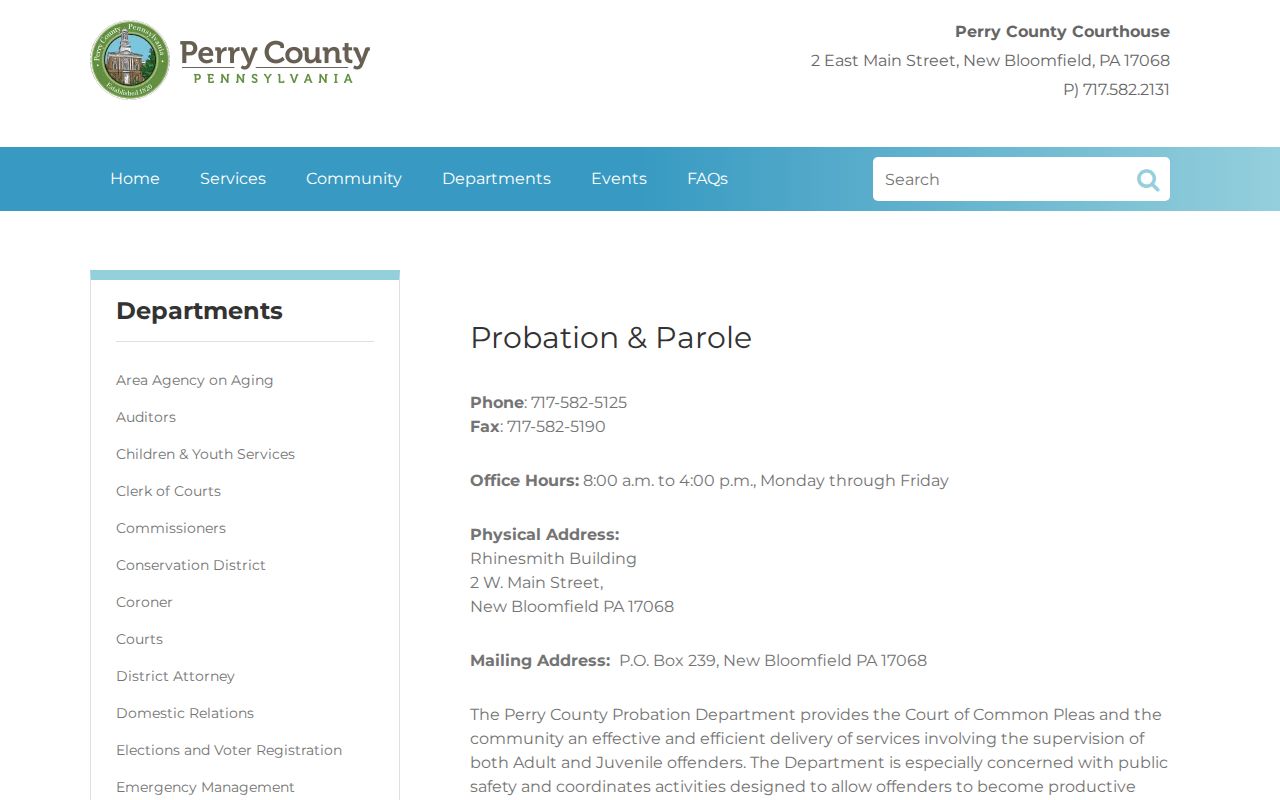
This source is the proper local starting point for office responsibility, hours, and contact, while the court order remains the source for the type of supervision.
Note: Perry County office contact can confirm responsibility when permitted, but it does not replace the public sentence or supervision order.
Perry State Parole Records
The Pennsylvania Parole Board does not publish a named-inmate hearing calendar or a searchable database of individual Board Actions. A clemency calendar from the Board of Pardons is not a parole schedule. For state cases tied to Perry County, the official substitutes are the parole interview process, the decision-factor page, and the Board’s forms and procedures.
Ordinary review begins around six months before the minimum sentence date. The Board may use a majority vote, two-person panel, RRRI hearing examiner, or short-sentence hearing examiner, depending on the route. The minimum date is an eligibility point. It is not a promised release day. A favorable decision may still require an approved plan and institutional processing before physical release.
Under 61 Pa.C.S. § 6139(a)(5), the Board records a decision, gives brief reasons for approval or refusal, provides it to the incarcerated person, and makes it releasable to the public at reasonable times. An individual Board Action can therefore be requested even though no public results search exists. Protected victim statements and personal material remain confidential under § 6140. Quote a grant, refusal, reparole decision, or recommitment only from the actual action.
The official decision-factor source is pictured below.
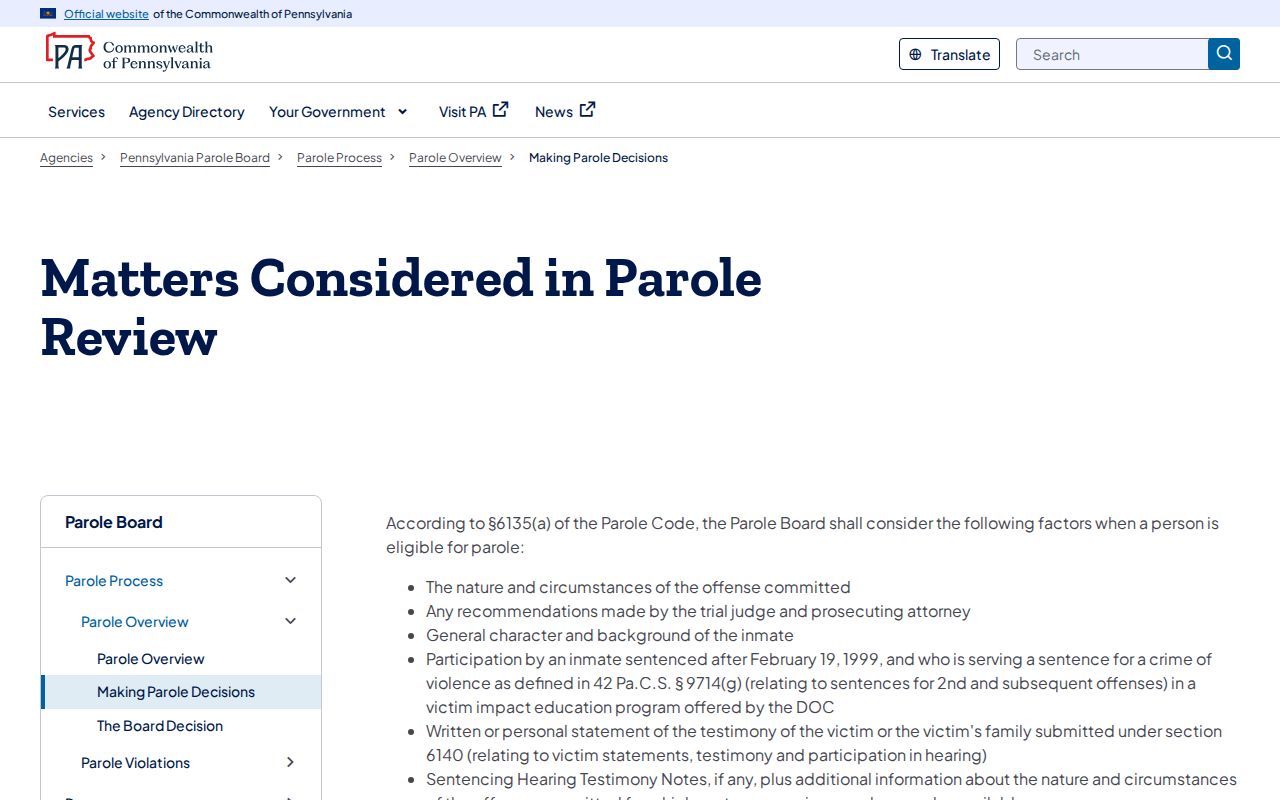
The image supports the distinction between Board review and an actual release event. A decision record must still be reconciled with custody and supervision records.
A refusal is not the same as a new sentence. It means parole was not approved through that review. A grant is also narrower than release because the institution may still need to complete planning and processing. When a Board Action refers to a future review month, record that phrase as a review milestone. Do not convert it into a projected release date. These distinctions are vital when a Perry County case began locally but the person later entered a state correctional institution.
Perry Parole Violation Status
Supervision conditions come from the court order, Board Action, and instructions given by the supervising agency. A violation allegation does not by itself explain current custody. The next document may be a county bench warrant, a state Board warrant, a detention event, a violation decision, or a recommitment action. The UJS docket can help with county court action, while the Board Action controls the state parole outcome.
Pennsylvania publishes a Most Wanted Absconders list for state supervision. An absconder is a person PADOC reports as failing to report as required. The list is not a directory of all parolees. A missing name does not prove compliance, discharge, or release. A listed name points to a supervision problem, not a fresh release from Perry County Prison.
Do not approach a listed person. PADOC directs tips to 800-932-4857 or RA-CRabscondertips@pa.gov. PA SAVIN may also report certain state-parole or custody events, but an alert is an event signal rather than the full legal ruling. Read the Board or court record for the actual status and reason.
Note: A review month after recommitment is a future review point, not a guaranteed Perry County parole release date.
Perry County Reentry Support
The Perry County Literacy Council Community Reentry Project works with Perry County Prison and the faith community. The program describes voluntary case management, mentors or sponsors, and continued access to community programs. It is a local support route after release, separate from parole or probation enforcement.
Participation does not establish that a person is on supervision. It also does not replace the sentencing order, Board Action, or agency confirmation. Its value is practical navigation. Someone returning to Perry County may use voluntary support while county probation, state parole, or no supervision at all applies under the legal record.
Keep those roles apart. Perry County Probation enforces local court terms. PADOC handles state parole field work. The Literacy Council offers voluntary reentry support. Clear labels protect both accuracy and dignity when reconnecting someone with services.
Note: Voluntary reentry support does not establish parole, probation, a violation, or discharge in a Perry County supervision record.
Perry Supervision Discharge Records
Supervision ends through a formal discharge or the end of the governing term, not merely because a person stops appearing in a locator. For a county case, look for a court order or confirmation from Perry County Probation. For a state case, use the Board Action, PADOC status, and any certified record. A parole grant shows conditional release was approved. A discharge shows the relevant supervision obligation ended.
Records can come from different offices. UJS holds the public court history. Perry County Probation can identify local office responsibility when disclosure is lawful. The Board records its parole decisions. PADOC maintains state inmate and supervision records. If a public locator no longer shows an older discharged person, a PADOC records inquiry or the court docket may be needed.
Work release and house arrest require care. Perry County assigns questions about both to the prison and Probation. Work release can permit set movement while institutional custody continues. House arrest places a person in the community under court restrictions and electronic monitoring. Neither phrase means unconditional discharge.
When a record seems inconsistent, preserve each source in its own lane. The prison record answers local custody. The UJS order states the court’s legal action. PADOC reports state jurisdiction or supervision. The Board Action states the parole decision. Perry County Probation can identify local supervision responsibility. A clear timeline may show release from one custodian followed by supervision or transfer, without suggesting that every legal duty ended at once.
Record rule: Verify the custodian, legal event, effective date, and supervising agency. Never infer final discharge from a missing name alone.