
Perry Scheduled and Actual Release
A projected date is an estimate or calculated milestone. An actual release date records when a person physically left a specific custodian. Pennsylvania’s public guidance does not provide one universal field called “projected release date” that guarantees departure. For a state sentence, the official terms are usually Minimum Sentence Date and Maximum Sentence Date when those labels appear in the PADOC record.
The minimum date is the first point when ordinary state parole authority can begin, subject to law. It is not a promise. The maximum date is the calculated sentence endpoint, subject to lawful changes. A Board grant date records a decision, while a release date records the custody event. A discharge date means the sentence or supervision duty ended. Keeping those labels apart prevents a parole milestone from being reported as freedom.
Pretrial detention works differently. A person held at Perry County Prison before sentence has no fixed sentence endpoint. Bail, dismissal, a release order, transfer, or later sentence may change custody. The docket and prison record provide the controlling event.
Scheduled versus actual: A minimum sentence date permits parole review. Only a recorded release event confirms departure from that custodian.
Find Perry Inmate Release Dates
The correct path begins with the sentence type. PADOC covers state-sentenced inmates and people on state parole. It excludes ordinary county-facility inmates. Perry County Prison and the sentencing court control county sentence records. A same-name state result cannot establish that a Perry jail detainee was released.
- Open the PADOC locator service for a state sentence. Follow its link to search inmates and parolees.
- Use the DOC number when known. Otherwise enter the last name, then use the first name to narrow a common surname.
- Compare stable identifiers and committing-county facts. Open the detail and copy the status, location, Minimum Sentence Date, and Maximum Sentence Date exactly as displayed.
- Reconcile the result with the UJS docket, including sentence, consecutive or concurrent structure, and later court orders.
- For a Perry County sentence, obtain the signed order and custody-credit record, then ask Perry County Prison or the Clerk of Courts for the authoritative calculation.
- Confirm physical release through the custodian, a release record, or a named-person PA SAVIN event. Do not use mere absence from a search.
PADOC says its locator updates daily. Some personal details may be self-reported, so last name or DOC number has more weight than a loose biographical match. The locator is also a current-jurisdiction and current-supervision tool, not a full archive of every old discharge. A fully discharged person may require a PADOC records inquiry. The Perry County released-inmate search covers the county record and court fallback.
The PADOC search form is shown below.
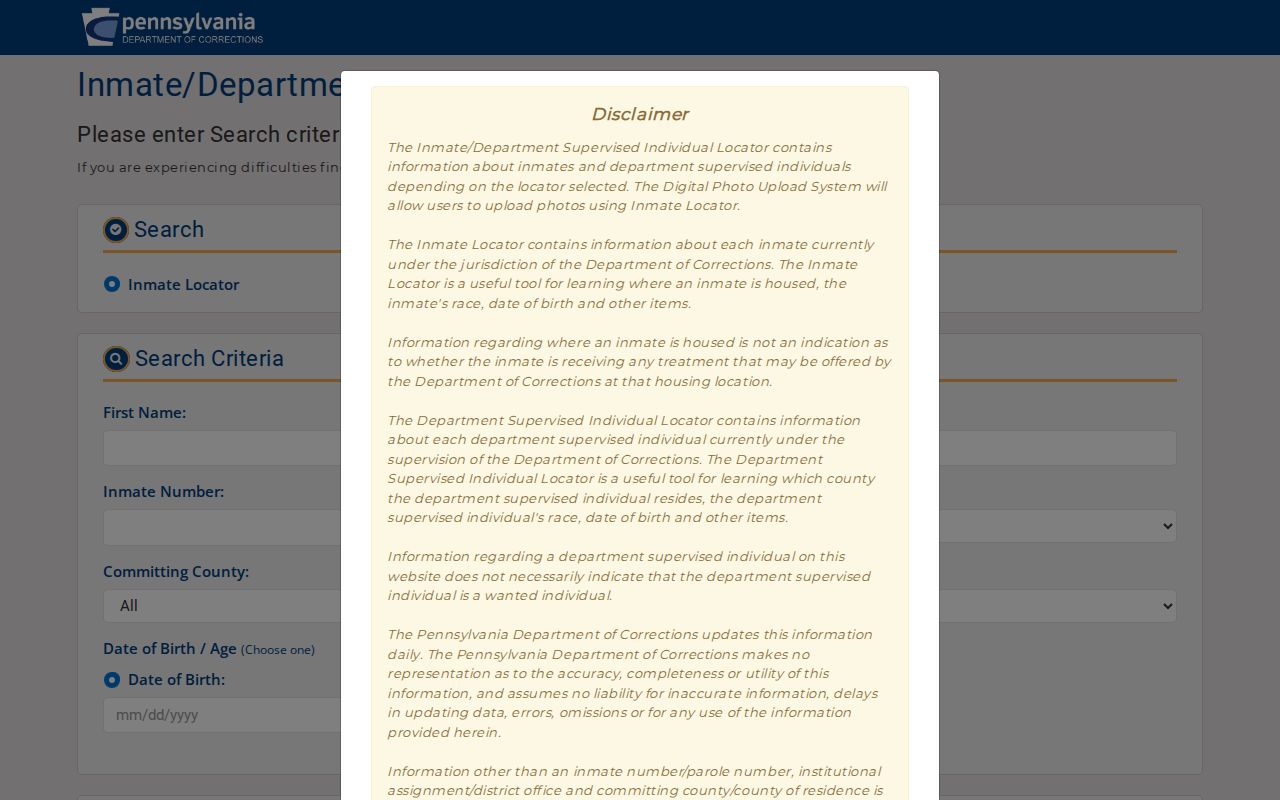
The official search separates state custody and supervision from Perry County’s local jail record, so the displayed labels must be read within that scope.
Perry Sentence Date Calculation
The calculation begins with the signed sentencing order, sentence commencement, and credit for prior custody under 42 Pa.C.S. § 9760. Consecutive terms run one after another, while concurrent terms overlap as the order directs. PADOC calculates minimum and maximum dates for state sentences. An amended order or corrected custody credit can change both.
Under 42 Pa.C.S. § 9756, a judge fixes the maximum and ordinarily sets a minimum no greater than half the maximum. For illustration, a one-to-two-year sentence ordinarily has a one-year minimum and a two-year maximum before lawful credit and other changes. The one-year point starts ordinary parole eligibility. If parole is refused, custody may continue toward the maximum.
- Minimum sentence date
- The first ordinary state parole eligibility date, not promised release.
- Maximum sentence date
- The calculated sentence endpoint, subject to lawful recalculation.
- Board grant date
- The date of a favorable parole decision, which may precede physical release.
- Release date
- The date custody ended for the named jail or prison.
- Discharge date
- The end of the relevant sentence or supervision duty.
A calculator built from public dates would be unsafe. One missing consecutive case, detainer, credit entry, or amended order can make the result wrong. Only the sentencing court and custodian can correct the official calculation.
Place of confinement is another key part of the record. Under 42 Pa.C.S. § 9762, the maximum term helps determine whether confinement is in county prison or PADOC. A Perry County booking may therefore disappear from local custody when a state commitment begins. That movement is a transfer, not a release to the community. Search PADOC and read the commitment order before describing the event.
The same sentence words can also have different practical effects. “Time served” may support immediate release once all holds are resolved. A parole-eligible minimum permits Board review but may lead to refusal. A maximum date may end the sentence, yet another active detainer can produce a handoff. Each result requires the custodian and destination field, not date arithmetic alone.
Note: Use the signed Perry County order and official credit calculation, since public dates alone cannot reveal every consecutive term or hold.
Perry RRRI Release Eligibility
Pennsylvania does not have a blanket rule requiring every incarcerated person to serve 85 percent of a sentence. The Pennsylvania Parole Board says so directly. Ordinary parole authority generally begins after the minimum under 61 Pa.C.S. § 6137. Life and death sentences are outside ordinary Board parole power.
Recidivism Risk Reduction Incentive, or RRRI, is a limited statutory route rather than universal good time. The court decides eligibility and directs an RRRI minimum under 61 Pa.C.S. Chapter 45. Section 4505 sets the formula. When the imposed minimum is three years or less, the RRRI minimum is three-fourths. When it exceeds three years, the RRRI minimum is five-sixths, with statutory rounding.
For illustration, an eligible two-year imposed minimum yields an eighteen-month RRRI minimum before the official calculation. An eligible six-year imposed minimum yields five years. Neither result guarantees release. Section 4506 also requires DOC certifications, program completion, no disqualifying misconduct, and Board action. Eligibility and the record control.
Short Sentence Parole under § 6137.1 is another narrow route for certain short state commitments, subject to statutory exclusions and conditions. It does not create an automatic county release formula. No official Perry County source published a local good-time table, weekend-advance rule, or online projected-date tool.
The official Pennsylvania parole process is shown below.
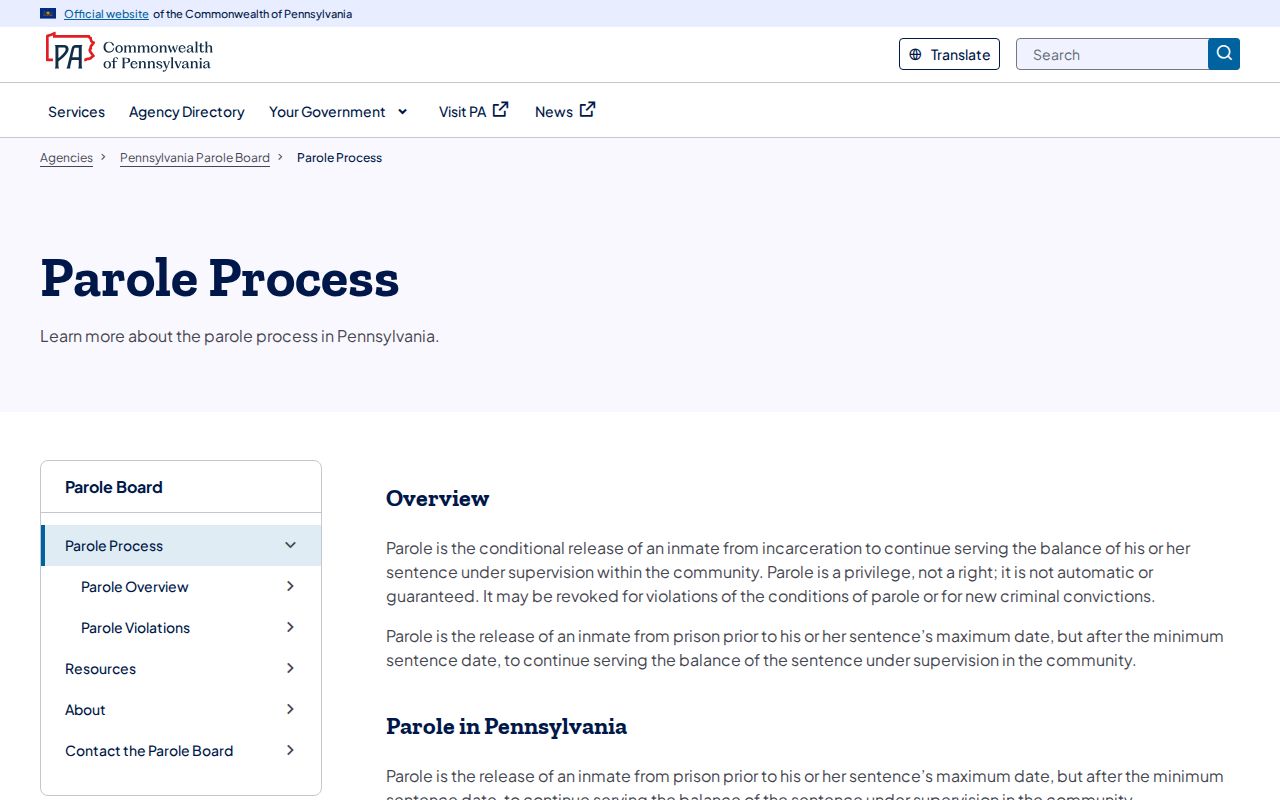
The state source confirms that minimum and maximum dates frame parole and sentence status, while the decision and release event remain separate records.
Perry Release Dates Can Change
Sentence dates may move because the legal or custody record changes. Some events alter the arithmetic. Others leave the dates intact but delay actual release. The official record should show which kind of change occurred.
| Factor | Effect on the date or event | Record to check |
|---|---|---|
| Corrected custody credit | May recalculate minimum and maximum dates | Amended order and custodian calculation |
| Consecutive or added case | Changes the aggregate sentence structure | Sentencing orders and UJS docket |
| Parole refusal | Prevents release at the eligibility point | Board Action |
| Detainer | May cause transfer to another custodian instead of community release | Release record and receiving-agency record |
| Violation or recommitment | Can recalculate state parole dates or return someone to custody | Board Action and PADOC record |
| Release-plan processing | May delay physical release after a favorable decision | Institution and supervision instructions |
Misconduct can affect eligibility for special programs, but it should not be described as a generic “good-time loss” unless the governing rule and record say so. Judicial or appellate action may also revise the sentence. Use the exact reason stated by the court, Board, or custodian.
A valid release plan can matter after a favorable state parole decision. Institutional processing may include approval of the plan and reporting instructions. That interval does not change a grant into a refusal, but it does mean the grant date and the physical release date are not interchangeable. If the person remains at an institution, the custody record still controls.
Perry Work Release Date Status
The Perry County Public Defender directs Work Release and House Arrest questions jointly to the correctional facility and County Probation. That local arrangement makes the custody label especially important. Work release can allow scheduled movement into the community while the person remains committed to Perry County Prison. It is not a final release date.
House arrest places a person in the community under court restrictions, often with electronic monitoring through Perry County Probation. It is not the same as discharge. Ask for the signed court order and identify the supervising office. If the order uses partial confinement, work release, or house arrest, preserve that term rather than converting it to “released.”
The Public Defender FAQ and Perry County Prison page establish the local routing. Neither publishes an automatic date formula. County time can involve court parole, credit, and partial confinement in ways that a public state locator does not show.
Note: Community movement under Perry work release or house arrest must not be recorded as final sentence discharge.
Confirm Perry Actual Release Dates
Use PA SAVIN through VINELink for a named-person event signal. Pennsylvania says the service covers county jails, state prisons, and state parole. A released or out-of-custody result means the reporting source sent a custody change. It does not always distinguish bond, sentence completion, transfer, or another legal result.
For a state sentence, compare the alert with PADOC status and the Board Action. For county custody, call Perry County Prison and read the UJS order. If historical proof is needed, request the existing release record with the actual timestamp, release authority, and destination or receiving agency. A transfer is not community release.
A well-formed county request should identify the full name, approximate admission range, and docket or booking number when known. Ask for the existing admission and release timestamps, the recorded release type or authority, and the destination or receiving agency if transferred. Those fields distinguish a true community release from movement to PADOC, another county, treatment, or a detaining agency. Perry County may redact protected parts or state that another office holds the record, but the response provides a far stronger date trail than a private estimate.
The Perry County VINELink release check explains registration and PIN steps. A notice should still be checked against the custodian because source updates can lag or be corrected.
For a certified state record, PADOC directs official inmate-record inquiries to its records channel. A county sentence stays with Perry County and the court. Keep copies of the order, locator result, alert, and release response with the date each was obtained. This makes later corrections or recalculations easier to trace and prevents an old screenshot from being treated as current.
Note: Record the exact source, label, and date checked so a later Perry County release-date change can be traced.